
Progress Check
Use this activity to assess whether you and your peers can:
- Compare distributions to determine whether the primary goal of random assignment is achieved.
Directions
Use the drop-down menu to learn about the three steps needed to complete this assignment.
Three steps to complete the assignment
Step 1: Review the Rubric
- Before you submit your work, review the rubric at the bottom of this assignment.
- Use the rubric as a checklist to determine whether you are ready to submit your work.
Step 2: First Draft
- Commit a good-faith effort to address each item in the Prompt section below.
- Please be sure to number your responses and include “white space” between problem numbers. This improves the readability and flow of your work. I cannot give feedback and grade jumbled work.
- Use either of the following options to submit your work.
OPTION 1: You can submit a text-entry assignment (i.e. typing your answers in Canvas). To learn how to submit a text-entry assignment, use these (opens in a new tab).
OPTION 2: You can upload your paper-and-pencil work (or the digital equivalent). To learn how to upload your paper-and-pencil work, use these (opens in a new tab). WARNING – some file types may not be visible on my end. So to learn which files you can upload, be sure to use the directions link I provided for this option. - Not ready to submit a good-faith effort yet? Avoid frustration – use the link to the Questions, Answers, & Tips discussion board (at the bottom of this page) to post questions about this assignment (or visit the discussion board to answer your classmates’ questions). You can also contact me directly (see the homepage for my contact information).
Step 3: Optional Final Draft
- After you submit your good-faith attempt to fully respond to the questions in the Prompt section below, advance to the ANSWER(S) page.
- You can use the ANSWER(S) page to correct your work and resubmit this assignment any time before I begin grading the problems. However, to earn full credit, you are not required to submit a final draft for this assignment. But if you do submit a final draft, I will only grade it if you submitted a good-faith effort on your first draft.
- Warning – I will only grade your most recent submission. So if you choose to submit a final draft, please do not leave anything out, and please do not direct me to read an earlier submission. To maximize your score, your most recent submission (at the time I begin grading) must be complete.
Context
A high school student named David Merrell did an experiment to examine if music affects the ability of mice to run a maze. The explanatory variable was exposure to music. He had three treatment groups: one group listened to heavy metal music by the group Anthrax. A second group listened to Mozart. The third group never heard music. This last group is the control group.
The response variable was the average time (in seconds) to complete three runs. Every week the mice ran the maze three times. Merrell recorded each mouse’s average time for the week.
Direct controls of potential confounding variables:
- Merrell trained all of the mice to run the same maze.
- He gave all mice the same amount of food and light.
- All mice had the same approximate age and weights.
- During the treatment phase, the mice were exposed to the treatment for the same amount of time, e.g. mice heard music at 70 decibels for 10 hours a day for a month.
Results:
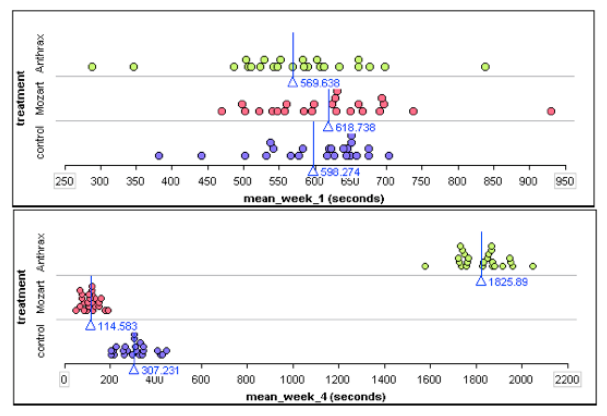
By the end of the month, the Anthrax group was much slower at running the maze. The Mozart group was much faster. The dotplots below show average run times for the first and last week of the experiment. Each dot represents one mouse. The X-value is the mouses average run time for the week. (Each mouse ran the maze 3 times each week.) The blue line is the mean run time for each treatment group.
If you are curious, here is a video of Merrell explaining his experiment.
()
Prompt
Merrell claims that he randomly assigned mice to treatment groups. Does the data shown in the dotplots above support his claim? Why or why not?
Module 6 Discussion Board
Use the Module 6 (opens in a new tab) to ask questions or provide feedback about the problems in any Module 6 activity – including this peer-reviewed assignment.
Review Feedback
- Instructor feedback is only available after an assignment is graded.
- Use these (opens in a new tab) to learn how to review feedback.
Click the “Next” or > button to continue.
Content by Cuyamaca College math faculty and licensed under the .
Rubric
Formative Assessments
| Criteria | Ratings | Pts |
|---|---|---|
|
This criterion is linked to a Learning OutcomeAnswering the Prompt |
|
10 pts |
Total Points: 10
Requirements: 5 h

Get this or a similar paper done in as fast as 4 hours, 24/7.
NB: We do not sell prewritten papers. All essays are written from scratch according to specific needs and instructions
Leave a Reply
You must be logged in to post a comment.