
PART 1
Purpose
Explain what you think makes a family
Instructions
Answer the following questions. Each question should have a 3-4 sentence response.
REMEMBER: Discussions are meant to mimic an in-class discussion. I want to hear your voice and thoughts. There are no correct or incorrect answers.
- Is family based on blood or biology, love and emotional connection, commitment or responsibility, living together, shared history, or something else? Why?
- Can someone be your family even if you are not related by blood? Explain.
- Has your definition of family changed over time? If so, what influenced that change (experiences, relationships, culture, media, etc.)?
- Do you think there is one right definition of family, or do definitions differ depending on culture, background, or personal experience? Explain your thinking.
PART 2
The size of a childs brain reaches 90 per cent of an adults by the age of five. Early childhood is a time of rapid change particularly for the development of a childs brain. These early years are critical for lifelong learning and well-being. Talking, reading, playing and singing with babies and toddlers is so important in shaping thinking and emotional patterns for life and influencing learning, relationships and resilience.
For this week’s discussion, please watch the video and respond to the prompts:
Discussion Prompts:
- After viewing the video, share two things that were new to you and explain why.
- Additionally, how can you share what you learned from the video with your peers or families?
Grading:
- The discussion assignment is worth a total of 10 points. Grading is based on your depth and detailed post and responses to two other post.
- Initial Post must be submitted by 11:59 PM on Friday for 5 points
- Your response to two other peer’s post must be submitted by 11:59 PM on Sunday for 5 point
PART 3-
GeneticsW3 Written Discussion Genetics
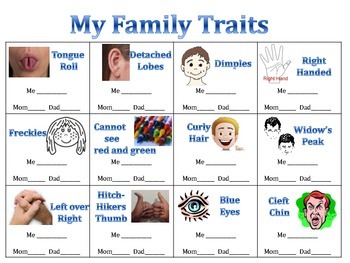
*Do not use the chart pictured here for your traits, it is just a graphic and does not match the traits we are looking at in this discussion!
Now that we all know each other a little bit it is time to get into the topic of Child Development. We are going to start at the beginning, prenatal development.
Our textbook lists several influences on prenatal development. Generally we think of environmental influences as those that occur once we are born. However, it is important to remember that on the day of their birth, infants have already been exposed to 9 months of environmental influences, and this exposure has occurred during a period of rapid growth and vulnerability. A healthy pregnancy with proper nutrition and prenatal care can promote developmental and put the newborn on an optimal path.
Recessive and Dominant Inherited Traits
Recently I discovered a great online resource for exploring and learning about heredity and genetics in a fun, hands on way. It’s a website developed by the University of Utah for educators from middle school through college to use when teaching about heredity and genetics.
The website for is full of fun activities, videos, and follow up materials. I want you just to explore all it has to offer. Seriously, don’t rush through this. It’s all about YOU! Discover the wonderfulness of you!
Discussion Assignment: Do this several days before the due date! This week your discussion response can be a written response instead of a video posting.
When you are done exploring the website, read the information on Recessive and Dominant Traits Handout and see which ones you have or don’t. Use this handout to record your traits:
If the handout won’t open for you, try opening it from the week 3 module.
- Make a list of the traits shown on the Dominant and Recessive Traits Handout.
- Now indicate which ones you have that are dominantly inherited and the ones you have that are recessively inherited.
First you will post your “Trait Train” and then you will explain how you came to these conclusions. My discussion response would look like this:
DDRRDRRRR
I base answers on this: my earlobes are detached (D), I can roll my tongue (D), I cannot wiggle my ears (R), I have no dimples (R), I clasp my hands w/left thumb on top (D), no cleft in chin (R), no widow’s peak (R), no hair on middle of fingers (R) and PTC tasting (R)
Make sure you put your D and R traits in the same order listed on the handout and that you have 9 traits! Make an educated guess on PTC tasting if you have never done this using a test strip in a science class before, use the information in this prompt to help you determine if you are a taster or not. Do this activity with at least one of your parents, or with your children (if you have any) to see what you inherited from your own parents or what you passed on to your children. If you can’t do it with a parent, then try the activity with your next closest relative. It could be a grandparent, or a sibling. Make sure you are using the handout and not the picture that is at the top of this post, that is just there for decoration!
Response: Choose one classmate and write a brief but meaningful comment in response to their post. Share about what you inherited from your parents or what you passed on to your child(ren). Be sure to post early in the week so people can see your traits, if everyone posts early in the week then it will be easier for others to find matches if they are trying to match with peers in the course. If most of the class waits until Friday to post then almost everyone will have to wait until Friday to find their matches and that will be frustrating.
Grading Rubric: View the grading rubric by clicking the settings icon in the upper right and select Show Rubric.
Requirements: Please place each part in a different attachment. NO AI USE PLEASE

Get this or a similar paper done in as fast as 4 hours, 24/7.
NB: We do not sell prewritten papers. All essays are written from scratch according to specific needs and instructions
Leave a Reply
You must be logged in to post a comment.